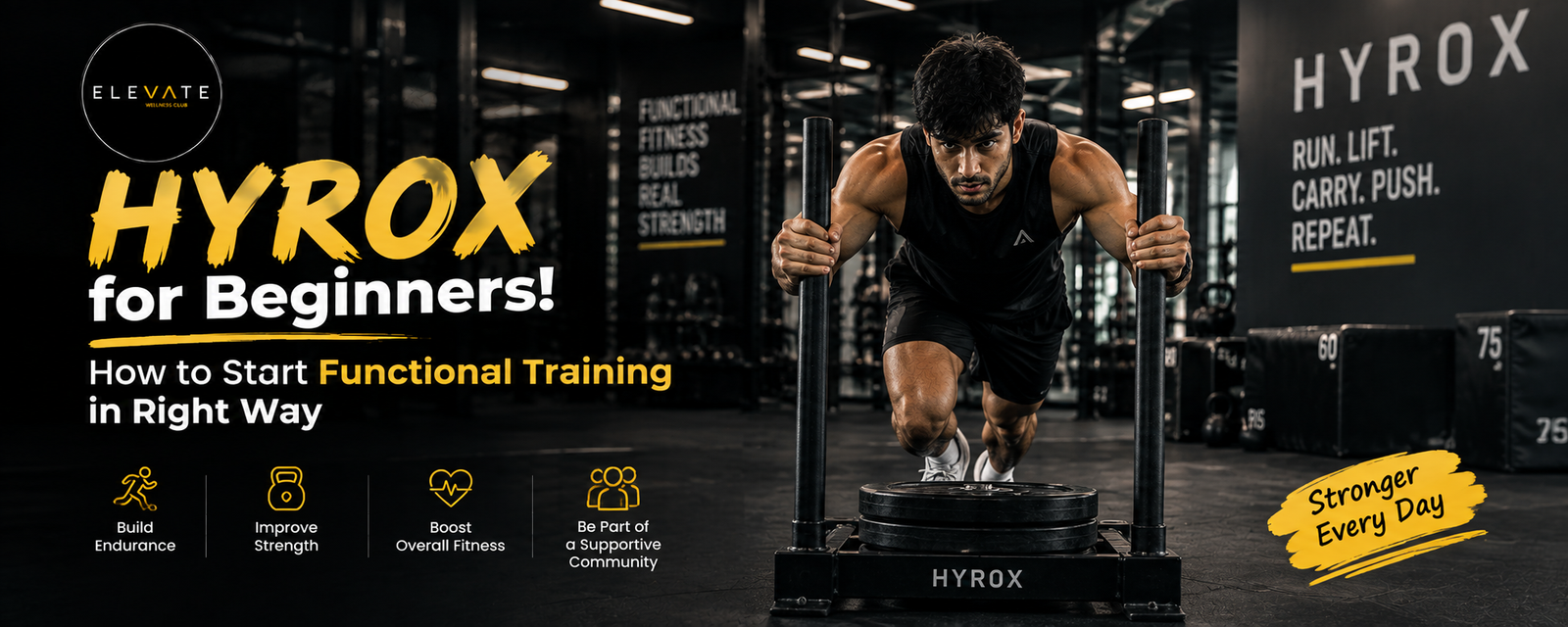
Your Instagram feed has probably shown you this already: someone dragging a weighted sled across a gym floor, red-faced, while a caption says “Day 1 of HYROX training.” It looks brutal and oddly fun at the same time. You think, I could try that. Then you Google it, and within five minutes you’ve got three conflicting opinions on where to even begin.
Is this just CrossFit with a new name? Do you need to already be fit to attempt it? Can you just copy the workout you saw online and hope for the best? That last one, especially, is how a lot of beginners end up injured in week two instead of race-ready in month three.
What HYROX Actually Is
Strip away the Instagram edit, and HYROX is a race with a fixed structure: eight 1-kilometre runs, each followed by a different functional station, sled push, sled pull, rowing, ski-erg, farmer’s carry, lunges, wall balls, and finishing with burpee broad jumps. Unlike CrossFit, which changes its workout daily and leans on Olympic lifts and gymnastics, HYROX never changes its format. Same eight stations, every race, everywhere in the world. That predictability is part of why people like it, you can actually train for something specific, instead of guessing what tomorrow’s workout will throw at you.
Why Everyone’s Suddenly Talking About It
A few things are feeding this. People like having a measurable goal instead of a vague one, “beat my last HYROX time” is a lot more concrete than “get fit.” It also solves a boredom problem: a lot of gym-goers who found running repetitive and lifting unmotivating suddenly have a reason to do both. And it’s social. People train in groups, compare splits, and show up to races together. That community pull matters more than people admit.
Where Beginners Usually Go Wrong
Nobody gets hurt because HYROX itself is dangerous. They get hurt because they skip the boring part.
Watch five HYROX clips on Instagram and you’ll see advanced athletes moving fast under fatigue. Copy that directly on day one, with no base fitness and no technique work, and you’re asking for trouble, a tweaked back on a sled push, or shot knees from untrained lunges under fatigue. The other common mistake is lopsided training: people either obsess over the strength stations and ignore their running, or train like a runner and never touch the sled.
And then there’s the burnout problem. Training hard every single day, with zero rest, works for about three weeks before your body makes the decision for you.
How to Actually Build Toward It
It starts boring. Before you touch the race format, spend a few weeks on general strength (squats, presses, rows) and regular cardio. That base makes everything after it safer.
Then break the stations apart. Practice a sled push on its own. Learn a wall ball rep without fatigue in the mix. A farmer’s carry with light weight, focusing purely on how you hold your spine. Technique when you’re fresh is completely different from technique in round six of a race, and that gap is exactly where injuries happen.
Once the pieces feel solid, start combining a strength day with a separate running or interval day through the week, and build in at least one real rest day. Nobody’s timeline here is the same; how fast you’re ready depends on where you’re starting from, so don’t benchmark yourself against someone’s highlight reel.
If your gym runs functional training or group conditioning classes, that’s a reasonable bridge between general fitness and race-specific prep, especially with a trainer watching your form.
None of this comes with guarantees. Readiness for an actual race varies hugely by person, and if you’ve got an existing injury or joint issue, get a doctor’s input before you load up a sled.
Do You Need a Dedicated HYROX Gym?
Not really. A handful of cities have specialised HYROX training clubs, but most of what a beginner needs, strength training, conditioning, and someone checking your form on loaded movements, doesn’t require a specialised label. What actually matters is whether someone’s watching you do a sled push or a loaded carry for the first few times, since those are the movements most likely to go wrong under fatigue.

Where This Fits If You’re Training in Panchkula, Mohali, Peer Muchalla or Zirakpur
True Elevate’s listed services include strength training, personal training and group fitness, which cover most of the groundwork this kind of training needs, even without running the exact HYROX format. A trainer can help you learn loaded carries and interval conditioning properly before you think about race-specific prep.
Thinking About Giving It a Shot?
If HYROX has caught your eye but you’re not sure your current fitness matches what it demands, book a free consultation at True Elevate and talk through a realistic place to start.
FAQs
1. Is functional fitness training safe for beginners?
Generally yes, when introduced gradually with proper technique guidance. Jumping into advanced movements or high intensity too soon raises injury risk.
2. What should I focus on first if I want to try HYROX eventually?
Start with general strength training and cardiovascular conditioning, then gradually introduce individual HYROX-style stations with proper form before combining them.
3. Can I train for HYROX at a regular gym?
Yes, many of the foundational movements and conditioning work can be built at a regular gym offering strength training and functional classes.
4. Is HYROX only for very fit or athletic people?
No, HYROX includes categories for a range of fitness levels, though reaching race readiness still requires structured, progressive training.
5. What’s the biggest mistake beginners make with HYROX training?
Copying advanced workouts or race-pace sessions directly from social media without building a fitness base first, which increases injury risk.